
Automatic Blog Post Generator: What to Look for Before You Automate
November 11, 2026

A content team can publish several polished-looking articles in a week and still create pages that repeat competitors, miss search intent, or make claims nobody checked. Those problems usually begin before the draft appears, when the tool has weak research inputs or the publishing workflow lacks review gates.
An automatic blog post generator should support a controlled content operation: researched topics, clear editorial direction, search-focused structure, and publishing rules that fit your CMS. Rankdesk is one option built around that wider workflow, rather than treating generation as the entire job.
Quick answer: how to evaluate an automatic blog post generator
Use this sequence before you automate content production:
- Test whether the tool researches your site, the search results, competitors, and the target audience's question.
- Check the editorial controls for voice, source handling, outlines, internal links, and required expert input.
- Review its SEO workflow for intent mapping, topical gaps, metadata, structured formatting, and content quality.
- Verify publishing integration controls, especially draft status, categories, authors, scheduling, and rollback options.
- Run a small pilot, inspect every output, and set approval rules before expanding volume.
How to evaluate automatic blog post generator research quality
Research quality determines whether a draft has a useful angle before writing begins. Ask to see the inputs behind the outline. A reliable workflow should identify the page type ranking for the query, recurring subtopics, missing explanations, and relevant pages already on your site.
For example, consider a five-location heating contractor that wants an article targeting "heat pump repair vs replacement." Its existing service page sits at /services/heat-pump-repair/, and it already has two older posts about heat pump maintenance. A weak tool produces a generic comparison with broad cost language and a vague recommendation to contact a technician.
A stronger workflow first finds the decision points readers need: system age, repair history, warranty status, performance changes, refrigerant availability, and a professional inspection. It also identifies internal links to the repair service page and maintenance guides. That creates a useful article plan with a defined job.
Check whether the tool can work from the following evidence:
- Current search results and the dominant intent behind them
- Your existing URLs, topical coverage, and internal-link opportunities
- Competitor page patterns and gaps worth addressing
- Approved business facts, products, service areas, and subject-matter notes
- Authoritative source material for claims that require verification
A tool that begins with only a keyword often produces interchangeable pages. Ask for a visible research brief or outline before approving generation. The AI competitor content analysis guide explains how to turn competitor review into specific content gaps rather than copying page structures.
Editorial controls to check before using an automatic blog post generator
Editorial control protects accuracy, brand fit, and usefulness. Look for ways to define the intended reader, the article's purpose, the tone, required sections, prohibited claims, and source expectations.
Return to the heating contractor example. The team adds a rule that repair-versus-replacement advice must avoid fixed pricing, because each system requires an inspection. It also requires a short checklist of symptoms that warrant a service call and a link to the relevant local service page. These instructions turn a generic topic into a page the business can stand behind.
Review the generated outline before the full draft. At this stage, catch shallow sections, missing practical steps, and assumptions that need an expert's input. Then review the draft for factual support, overconfident recommendations, and language that sounds unlike the business.
Google's guidance on creating helpful, reliable, people-first content supports this approach. Useful pages demonstrate clear experience and purpose, and they provide information readers can act on.
Compare SEO and publishing capabilities before you automate
A tool can produce readable paragraphs while still leaving major SEO work unfinished. Evaluate the full operating path from topic selection through publication and measurement.
| Evaluation area | Evidence to request during a trial | Pass standard | Failure sign |
|---|---|---|---|
| Search intent | Research brief and proposed page type | The outline matches the question behind the query | A generic article template appears for every keyword |
| Topic coverage | Subtopics drawn from results, site gaps, and expert notes | Each section has a clear reader need | Headings repeat similar ideas with different wording |
| Internal linking | Suggested relevant URLs from your site | Links help readers reach services, products, or next steps | Links are random, broken, or absent |
| Editorial review | Draft status, revisions, and approval checkpoints | A reviewer can edit before publication | Publishing happens immediately after generation |
| CMS publishing | Category, author, slug, schedule, and featured-image controls | The post arrives with the intended settings | Manual cleanup is needed on every post |
| Quality safeguards | Duplicate checks, claim review, and page-level monitoring | Exceptions are surfaced for review | Low-value pages accumulate without a signal |
For WordPress sites, evaluate the publishing path separately from the writing quality. WordPress supports content operations through its REST API documentation, but a usable workflow also needs practical controls for drafts, taxonomy, authorship, and scheduling. Publish the first pilot posts as drafts. Inspect the finished page on the site, including headings, links, images, excerpt, and canonical settings.
The contractor's pilot could include three articles: repair versus replacement, heat pump maintenance by season, and warning signs before a winter breakdown. The team discovers that the first draft links to a general contact page instead of the repair service page. That is a useful pilot finding. Update the linking rule, regenerate or edit the draft, and verify the next article follows the rule.
Google also publishes spam policies for web search that cover scaled content abuse. A high publishing rate does not protect a site from quality problems. Each page needs a clear purpose and genuine value for its intended reader.
How Rankdesk supports a controlled automatic blog post generator workflow
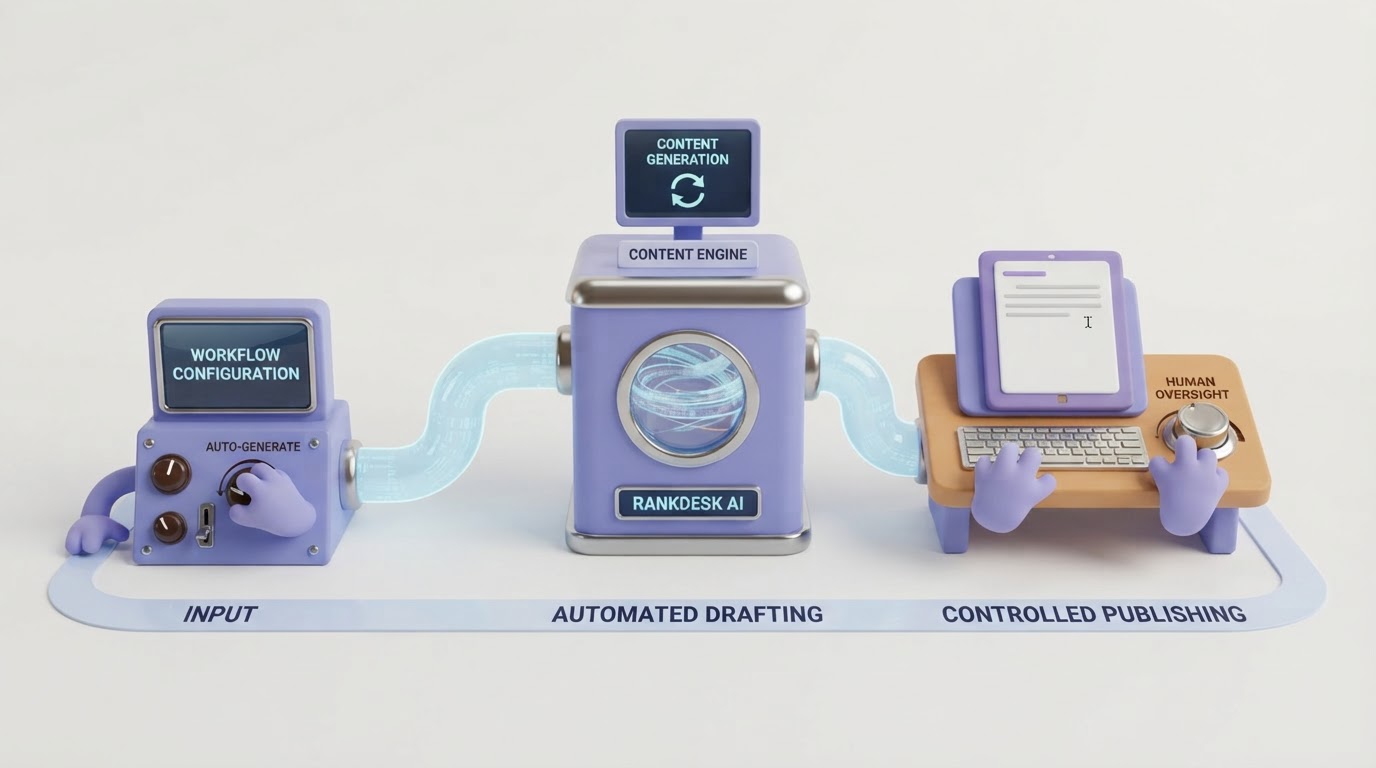
The most useful automation removes repetitive research and production work while keeping your team responsible for decisions and approval. Rankdesk's workflow is designed around those stages.
Start by connecting the site context and selecting the topics that support a real business goal. Rankdesk researches the site, competitors, and keywords so the content plan can account for existing pages and search opportunities. For the heating contractor, that means treating /services/heat-pump-repair/ as a page to support, rather than creating another article that competes with it.
Next, create the article or landing page from that research. Review the proposed angle, structure, and draft against your service knowledge before it reaches the CMS. Add the specific details only the business knows, such as diagnostic process, seasonal availability, or the boundaries of a service area.
Then use the publishing workflow that fits the site's operating rules. A WordPress team may send posts to draft for editorial review, while a mature content team may schedule approved topic types. See the available Rankdesk integrations and the broader feature set before choosing the workflow.
Finally, revisit pages after publication. Check whether impressions, clicks, query patterns, and internal-link paths show that the article is reaching the right audience. Refresh pages where the search results change or where subject-matter expertise can improve the answer.
This sequence also supports visibility in AI-assisted search. Clear entity references, direct answers, sourced claims, and pages with a distinct purpose make content easier for systems to interpret and cite. The practical steps in how to get mentioned by ChatGPT apply the same discipline to source-worthy content.
Safeguards that prevent low-quality automated content
Automation needs explicit stop points. Establish them before the content calendar expands.
First, require human approval for topics involving health, legal, financial, safety, product specifications, or time-sensitive facts. Second, maintain a source and claim policy. A writer or reviewer should be able to trace important statements to approved documentation, original research, or verified business knowledge.
Third, prevent topic overlap. The heating contractor does not need five articles that all target variations of "heat pump repair." Map one primary purpose to each URL, then use supporting posts to answer adjacent questions and link toward the main service page.
Fourth, measure more than publishing count. Monitor indexation, impressions, clicks, rankings for relevant queries, conversions where appropriate, and manual review findings. A page with impressions but weak clicks may need a better title or a closer match to intent. A page with no impressions may need stronger topical support, a clearer target, or a decision to consolidate it with another URL.
Teams that need a wider operating model can use the content automation workflow guide. Keep a simple log of approved topics, review decisions, source requirements, and updates. That record makes quality control repeatable as authors and campaigns change.
Common mistakes when choosing an automatic blog post generator
The most expensive mistake is evaluating a tool from one impressive sample. A single broad topic can hide weak research, poor internal linking, and inflexible publishing settings. Use three test topics with different intent: a comparison, a problem-solving guide, and a commercial-supporting article.
Another mistake is treating word count as a quality signal. A 2,000-word page can still leave the reader without a decision framework, a useful example, or verified guidance. Score the draft against the research brief instead.
Publishing every draft immediately creates avoidable risk. Set initial posts to draft, review the rendered page, and graduate only reliable topic types to a faster workflow. The same caution applies to competitor comparisons. Check factual claims against current product information, and avoid copying competitor framing when your research shows a better answer for your audience.
FAQ
Can an automatic blog post generator create content that ranks on Google?
It can support ranking work when the workflow starts with a valid search opportunity and ends with a useful, well-reviewed page. Rankings also depend on site authority, technical accessibility, internal links, competition, and the page's ability to satisfy the query better than available alternatives.
Should I publish generated posts as drafts or publish them automatically?
Begin with drafts. Move toward scheduled publication only after a pilot shows dependable research, accurate content, correct linking, and clean CMS formatting for a defined group of topics. High-risk subjects should retain a human approval step.
What should I review in an automatically generated blog post?
Review the search intent, factual claims, required expert details, heading logic, internal links, title, meta description, calls to action, and the rendered CMS page. Check whether the article answers the reader's main decision early instead of burying it below broad background information.
Can automated content help earn citations from AI assistants?
It can improve the underlying conditions when articles offer direct answers, clear entities, original expertise, and well-supported claims. No platform can promise citations from any AI assistant. Build pages that deserve to be used as a source, then maintain them as facts and search behavior change.
If you want a more consistent way to assess, plan, write, and publish search-focused content, see how Rankdesk works. It researches your site, competitors, and keywords, then creates articles and landing pages you can review or publish automatically.