

AI Competitor Analysis Tool for Better SEO Content
Competitors can publish dozens of pages before your team has finished choosing the next topic. A spreadsheet of URLs rarely explains which gaps deserve attention, what readers expect from the page, or where your own expertise can create a stronger result.
An AI competitor analysis tool turns that research into a prioritized content plan. Obbio.ai helps teams connect research, content production, and publishing so useful competitor findings reach the page rather than remaining in a document.
Quick answer: how to use an AI competitor analysis tool
Use this workflow to move from competitor URLs to publishable SEO opportunities:
- Define one commercial topic and list the pages on your site that already serve it.
- Collect the leading organic results and direct competitor pages for that topic.
- Compare search intent, page format, entities, proof points, and unanswered questions.
- Score gaps by business relevance, available evidence, and overlap with existing pages.
- Build a brief with a unique angle, internal links, source requirements, and a conversion goal.
- Draft, fact-check, publish, and measure impressions, clicks, rankings, and assisted conversions.
What an AI competitor analysis tool should find
A useful analysis begins with pages, then turns them into editorial decisions. It should surface recurring patterns in the search results: comparison pages, service pages, templates, product-led guides, pricing explainers, and informational articles that support commercial pages.
Look beyond headings. Capture the audience each page serves, the decision stage, claims that require proof, linked product pages, examples, and gaps that remain unanswered. Google explains that its ranking systems aim to prioritize helpful, reliable, people-first content in its guidance on creating helpful content.
The most valuable finding is often a missing decision aid. A competitor may explain features thoroughly yet omit migration steps, implementation limits, ownership rules, or a worked example. Those gaps can become a stronger page section when your business can support the answer.
A practical example: a payroll software firm
Consider a fictional B2B payroll platform, Ledgerline, targeting “payroll software for contractors.” Its existing URL, /contractor-payroll, describes tax calculations and payroll runs. A competitor review finds three recurring page types in the results: broad product pages, 1099 compliance guides, and comparison articles.
The first draft brief proposed a generic guide to contractor payments. Research showed a better opportunity: buyers needed a clear workflow for handling mixed W-2 and 1099 teams, plus a checklist of records to prepare before the first pay run. Ledgerline has direct product knowledge for that workflow.
The resulting brief keeps /contractor-payroll as the commercial destination and assigns a supporting article around onboarding records, payment timing, and handoffs with finance. It also links to a comparison page for buyers evaluating options. This avoids two pages competing for the same broad intent.
How to compare competitor content for SEO opportunities
Export the top results for your target term first. Include direct business competitors where relevant, yet treat the search results as the primary evidence of what Google currently returns.
Review each URL through the same fields. Consistency makes patterns visible and stops the loudest competitor from setting the plan.
| Review field | What to record | Editorial decision it supports |
|---|---|---|
| Search intent | Research, evaluation, purchase, or support intent | Choose the page type and primary call to action |
| Page scope | Main question, subtopics, and omitted questions | Define a focused angle with useful coverage |
| Evidence | First-hand examples, sources, screenshots, methodology | Identify proof your page needs |
| Information architecture | Headings, internal links, tools, and comparison elements | Build a clear page structure and link path |
| Conversion path | Demo, quote, product page, template, or newsletter | Match the offer to reader readiness |
For Ledgerline, the broad product pages held purchase intent, while the compliance guides attracted readers researching a specific operational problem. Publishing another broad product page would create overlap. The team chose a supporting guide with a direct internal route to the service page instead.
Use Google Search Console to check whether an existing URL already receives impressions for the target theme. The Search Console Performance report documentation explains the available search metrics and filters. Export the previous 90 days, group queries by intent, and record pages with meaningful impressions before commissioning a new URL.
How to prioritize competitor gaps with an AI competitor analysis tool
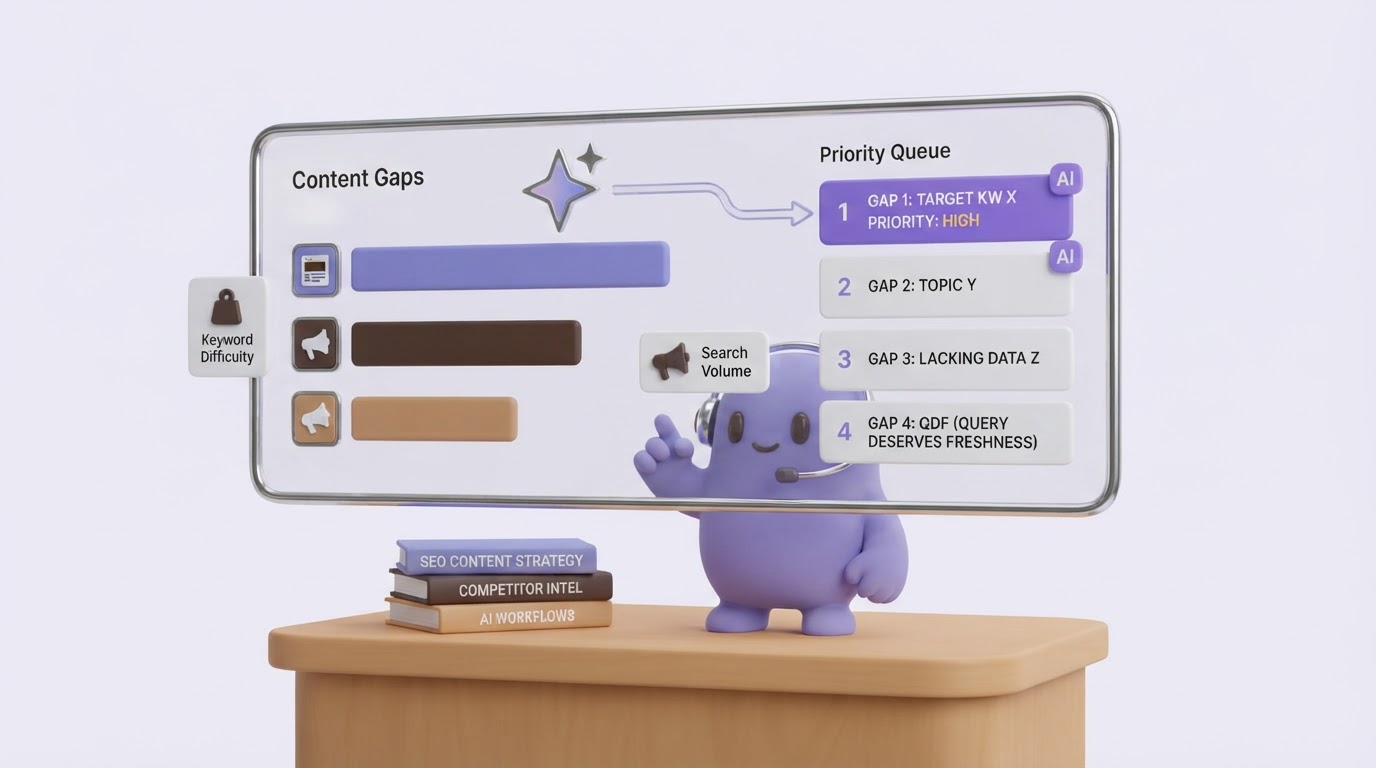
Prioritization prevents competitor research from becoming a list of interesting observations. Score each possible page against three practical questions: Does it support a valuable audience? Can your team add direct evidence or experience? Does it have a clear place in the current site structure?
Ledgerline rejected a proposed “best payroll software” roundup because it lacked a defensible comparison methodology and would require ongoing vendor maintenance. The mixed-worker onboarding guide passed the test. Its product team could validate the process, the topic connected directly to the contractor payroll page, and the article gave sales a useful resource for discovery calls.
Keep the final brief concise enough for a writer to act on. Include the target audience, search intent, desired URL, main promise, required expert input, supporting sources, internal links, and the action a qualified reader should take.
For more detail on turning these findings into a production brief, see this guide to using an AI content writer with competitor research. Teams planning larger content libraries can also use the workflow in how to automate SEO content creation.
How Rankdesk turns competitor research into publishable content
Manual research works well for a small number of high-value pages. The workload grows quickly when multiple markets, services, or product categories need consistent coverage. Rankdesk is designed to carry the workflow from discovery to a reviewed draft and publication.
Start by adding your site and choosing the subject area you want to grow. Rankdesk researches your existing site, relevant competitors, and keyword opportunities so the content plan begins with context instead of a blank document.
Next, review the proposed topics and choose the pages that fit your commercial priorities. For the Ledgerline example, the team would select the mixed-worker onboarding topic, keep the contractor payroll page as the conversion destination, and add required product details for the draft.
Then generate the article or landing page and review the output before it goes live. Check claims with a subject expert, add any product screenshots or customer-specific language, and confirm that the internal links point readers toward the appropriate next step. The Obbio.ai features page and how it works overview explain the broader content workflow.
Finally, publish through a supported platform or use the draft in your normal editorial process. A WordPress team, for example, can use the WordPress integration to maintain a reliable path from approved content to the live site. Keep a review gate for regulated claims, product details, and pages that shape a buyer's decision.
This workflow also supports visibility in AI-assisted search experiences. Clear entity references, well-supported claims, and purposeful internal linking give systems more context to interpret your content. Read how to get mentioned by ChatGPT for a practical approach to building that coverage.
Common mistakes with AI competitor analysis tools
The first mistake is copying the heading structure from the current leader. Search results can reveal reader expectations, while your page still needs an original contribution. Add operational detail, original examples, expert review, or a clearer decision framework.
The second mistake is treating every ranking URL as a direct competitor. A publisher, a marketplace, a government source, and a software vendor may appear for the same query. Their purpose and ability to convert differ sharply. Classify the result before using it as a model.
The third mistake is creating a new page when an existing page needs expansion. Check query-level impressions, topical overlap, and internal links first. Consolidating content can produce a clearer architecture than adding another thin URL.
FAQ about AI competitor analysis tools
What should an AI competitor analysis tool analyze?
Analyze search results, competitor URLs, your existing pages, target queries, internal links, content formats, and evidence gaps. The output should help a team decide what to publish, improve, merge, or leave alone.
Can competitor analysis help with AI search visibility?
Yes. Competitor analysis can reveal which entities, questions, sources, and page structures recur around a subject. Build on those observations with accurate, attributable information from your own experts. The AI search optimization page covers this broader content objective.
How often should I run competitor content analysis?
Run a full review before building a new topic cluster, refreshing important commercial pages, or entering a new market. Revisit priority topics when rankings shift, product positioning changes, or Search Console data shows new query patterns.
Should agencies use one competitor research process for every client?
Use one consistent framework and adapt the research inputs, approval requirements, and conversion goals for each client. Agencies also need clear separation between client sites, competitor sets, and subject-matter review. See Obbio.ai for agencies for the agency use case.
If competitor research keeps ending in disconnected documents, see how Rankdesk works. It researches your site, competitors, and keywords, then creates articles and landing pages for review or automatic publishing.