

AI Content Writer for Search-Focused Pages and Articles
A content backlog usually grows because research, briefing, writing, editing, and publishing sit in separate queues. Obbio.ai helps bring those steps together through Rankdesk, so teams can build search-focused articles and landing pages from a single working process.
Quick answer: how to use an AI content writer for SEO
Use an AI content writer effectively with this workflow:
- Choose a page type, audience, and search query with a clear business purpose.
- Review the ranking pages and your existing URLs to find missing coverage.
- Build a brief with first-hand expertise, product details, and internal links.
- Generate a draft around a specific page goal, then edit claims and examples.
- Add on-page SEO elements, publish through your CMS, and measure impressions, clicks, and conversions.
How an AI content writer turns a keyword into a useful page
Start with a page decision rather than an empty prompt. A commercial page needs a different angle from a comparison, guide, category page, or support article. Define the reader, their job, and the next action before drafting.
Take a hypothetical outdoor retailer with an existing category at /collections/waterproof-hiking-boots. Its team wants traffic around “waterproof hiking boots for winter hiking.” The first instinct is to publish a broad 2,000-word buying guide. A review of the category page shows a more useful route: expand the category with insulation guidance, terrain recommendations, fit advice, and links to relevant products. The business already has product knowledge. The page needs structure and proof.
An AI content writer should receive those inputs: the category URL, available boot attributes, target terrain, customer questions, and internal destinations. That gives the draft material to work from beyond generic web patterns.
Google’s guidance on helpful, reliable, people-first content supports this approach. Demonstrable expertise, a clear purpose, and original information create stronger pages than broad rewrites of ranking articles.
Research before you generate AI content
Research determines whether the draft earns its place on the site. Export the current keyword set, identify the ranking URL for each term, and group terms by the page that should answer them. Avoid creating several pages that all target the same intent.
For the outdoor retailer, the research reveals three distinct opportunities:
- Improve the waterproof boot category for shoppers ready to compare products.
- Publish a winter hiking boot guide for readers choosing insulation and traction.
- Add a care article covering waterproof membrane maintenance after purchase.
That split prevents the category page from trying to answer every adjacent question. It also creates logical internal links among pages with different jobs.
Competitor research needs the same restraint. Look for content gaps, page formats, evidence, and subtopics that repeatedly appear among credible results. Copying a competitor outline produces familiar pages. Use your inventory, sales calls, product documentation, and support questions to create a more specific answer. See the detailed process in this guide to using an AI content writer with competitor research.
Create briefs that give the draft real expertise
A useful brief includes facts the model cannot infer reliably. For the hiking boot category, add tested temperature ranges from product specifications, a definition of each waterproof technology used in the catalog, fitting notes from the returns team, and product-to-use-case recommendations.
The initial draft in this example made a common error: it treated every waterproof boot as suitable for icy trails. The editor corrected that claim by separating water resistance from traction and insulation. The resulting category copy directs icy-condition shoppers toward boots with the right outsole and warmth profile.
Use a brief that answers these questions in prose or fields:
- Which URL will rank and what action should readers take?
- What first-hand details, policies, data, or product facts belong on the page?
- Which claims require a source or subject-matter review?
- Which internal pages help the reader make the next decision?
- Which sections belong on this page rather than a separate URL?
Structured data can clarify eligible page information for Google when it accurately reflects visible content. Follow Google’s structured data introduction and validate the markup before release.
AI content writer workflow: manual work versus a connected process
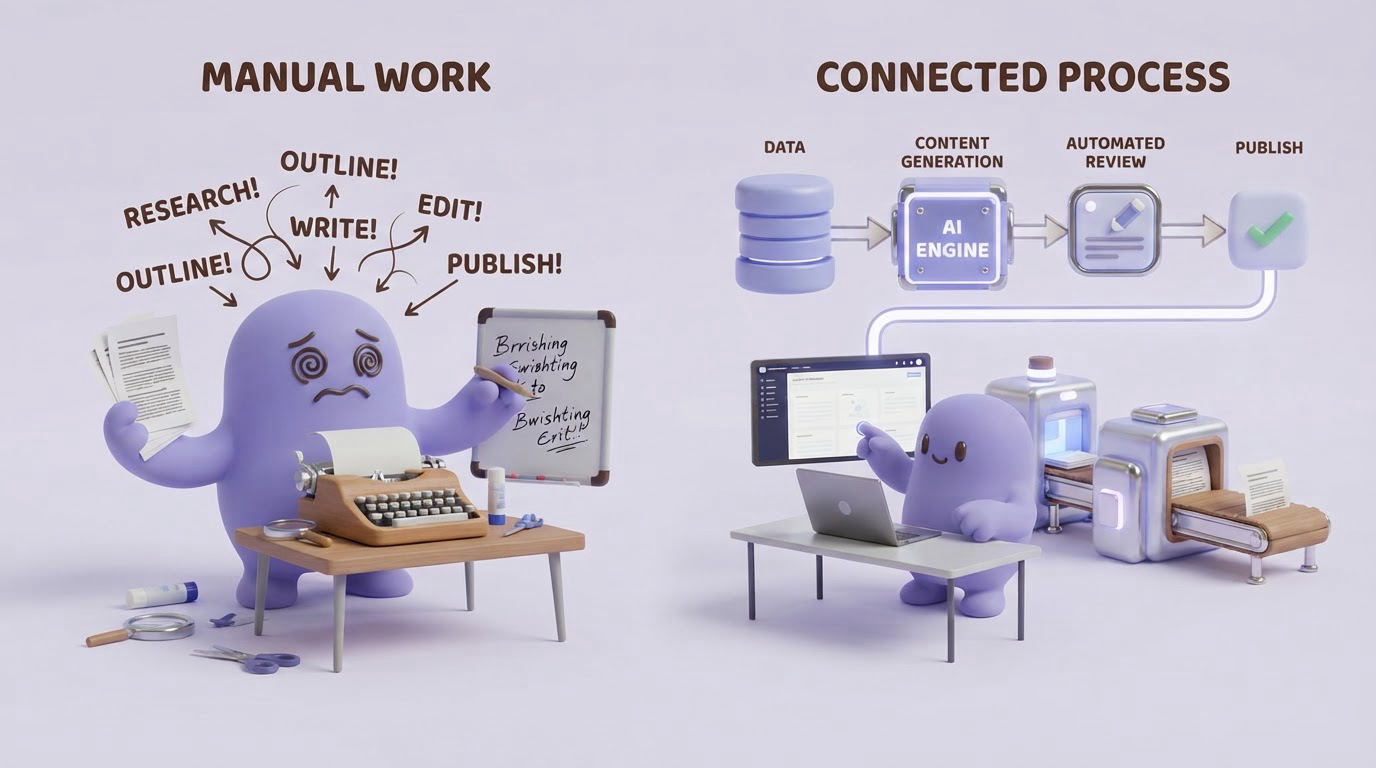
The table shows where time and quality often diverge during production.
| Workflow stage | Disconnected writing process | AI content writer process with Rankdesk |
|---|---|---|
| Research | Spreadsheets, browser tabs, and separate keyword notes | Site, competitor, and keyword research informs the content task |
| Briefing | Writer reconstructs context from several documents | Page goal, target topic, and source material stay connected to the draft |
| Drafting | Repeated prompts and manual outline assembly | Article or landing page draft begins from the selected research direction |
| Review | Editors search for unsupported claims and missing links late | Review the page purpose, factual details, links, and brand input before publication |
| Publishing | Copy and formatting move manually into the CMS | Publish after approval or use an automated publishing route where appropriate |
Manual editing remains essential for claims, product details, legal language, and brand judgment. The software shortens repetitive research and drafting work while keeping those decisions visible.
Use Rankdesk with WordPress to improve content output
For WordPress teams, the practical goal is a dependable path from research to a published URL. Focus on the page’s performance after it goes live: indexability, internal links, title clarity, product or service relevance, and evidence that supports the reader’s choice.
Here is how the hiking boot example works in Rankdesk. First, the team chooses the waterproof boot category opportunity and reviews its existing URL alongside competitor coverage. Next, they provide the product facts and decide that the category page, rather than a new guide, should carry the main commercial intent. Rankdesk creates the working draft, including sections for use cases, fit, care, and relevant category links.
An editor then checks every product recommendation against current inventory and adjusts the copy for the retailer’s voice. After approval, the team sends the content into its WordPress publishing workflow, confirms headings and links in the live preview, and tracks the page in Search Console. This keeps the content operation centered on outcomes rather than a one-off generated document.
For broader publishing governance, read the guide to automating SEO content creation and the practical approach to content automation for SEO publishing. Agencies can also apply the same review model across client accounts with an AI content writer for agencies.
How AI content supports Google rankings and AI assistant citations
Search rankings and AI assistant visibility benefit from content that clearly establishes what your business offers, who it serves, and which evidence supports its claims. Build topical coverage around real commercial entities: products, services, locations, authors, policies, specifications, and customer problems.
For the retailer, that means consistent naming for waterproof technologies, clear product attributes, complete category descriptions, and links between the care guide, winter guide, and collection pages. Those details help search systems interpret the site and give AI assistants grounded material when users ask product research questions.
Publish pages that answer specific questions fully, cite sources where needed, and keep factual information current. The process for strengthening entity signals and earning relevant AI assistant mentions is covered in this guide to getting mentioned by ChatGPT.
Common mistakes when using an AI content writer
The most expensive mistake is publishing drafts that contain vague claims no one on the team can verify. A fast first draft becomes a slow cleanup when the brief lacks product facts, sources, and a defined page purpose.
Another failure mode is publishing near-duplicate pages for every keyword variation. Consolidate closely related terms into the strongest relevant URL. Give each new page a distinct audience need and internal-link role.
Finally, measure more than output volume. Review indexed pages, search impressions, qualified clicks, assisted conversions, and the editorial changes that recur across drafts. Those signals show which parts of the workflow need better research or stronger source material. For a full plan-write-publish model, explore Obbio.ai’s guide to SEO content software.
FAQ about AI content writers
Can an AI content writer create landing pages as well as blog posts?
Yes. Landing pages need tighter control over intent, proof, objections, internal links, and conversion paths. Provide product details, audience context, and the intended action before generating the draft.
Should every AI-generated draft be reviewed by an editor?
Yes. Assign review ownership for factual claims, subject expertise, brand language, compliance requirements, and product availability. Editors also catch pages that overlap with existing URLs.
Can Rankdesk publish content automatically?
Rankdesk supports a workflow where teams can review content before release or use automated publishing when that fits their governance process. Keep a clear approval standard for pages involving pricing, regulated topics, product specifications, or sensitive claims.
How many keywords should one AI content page target?
Choose one primary intent and include closely related terms that the same reader expects on that page. Split the work when queries lead to different page formats, audiences, or actions.
If you want a more consistent way to plan, write, and publish search-focused content, see how Rankdesk works. It researches your site, competitors, and keywords, then creates articles and landing pages you can review or publish automatically.