

SEO Article Writer: Create Content That Ranks and Earns AI Citations
A publishing calendar can look healthy while organic traffic stays flat. The usual cause is weak topic selection, thin source material, or articles that never make a clear claim a reader or AI assistant can cite.
An SEO article writer gives you a repeatable way to turn search demand and business expertise into publishable pages. Rankdesk from Obbio.ai supports that process by researching opportunities, producing structured drafts, and preparing content for review or publication.
Quick answer: how to use an SEO article writer
Use this workflow to create articles that support Google visibility and AI citations:
- Choose one search query with a clear reader problem and a page type that fits the result.
- Research the current results, your site, competitor gaps, and primary sources.
- Build a brief with a direct answer, unique examples, internal links, and source requirements.
- Draft the article around the reader's decision or task, then add evidence and firsthand detail.
- Review claims, headings, links, metadata, and structured data before publishing.
- Measure impressions, clicks, rankings, and assisted conversions, then refresh pages with declining relevance.
How an SEO article writer chooses topics worth publishing
Start with a real commercial or informational job. A strong topic connects a searcher's question to a useful next action on your site. Broad phrases can bring traffic, while specific questions often bring readers closer to a purchase, consultation, comparison, or product evaluation.
Take a WordPress site for a manufacturer of commercial water filters. Its team wants more qualified leads from facility managers. Instead of publishing a generic post about water quality, the SEO article writer selects “how often to replace a commercial water filter.” The query has a practical answer, supports the manufacturer's replacement products, and creates a natural path to a quote page.
The brief should establish:
- The primary query and the reader's role
- The action the reader should take after reading
- The product, service, or expertise that supplies original detail
- The pages that deserve internal links
- The sources required for factual claims
Export the last 90 days of Search Console data first. Look for pages with high impressions and weak click-through rates, then find adjacent questions those pages fail to answer. Google explains how its systems prioritize helpful, reliable, people-first content in its guidance for creating helpful content.
For a broader process that includes gap research and editorial review, see this guide to automating SEO content creation.
How to research an SEO article before writing
Research determines whether the draft contributes something useful. Read the leading pages to identify the expected format, recurring subtopics, and unanswered questions. Then move beyond the results page with product documentation, standards, customer-support conversations, sales-call notes, and subject-matter expert input.
In the water-filter example, the first outline missed a key operational variable: water hardness. A facilities manager may need a replacement schedule based on flow volume, contaminant load, and local water conditions. The revised article includes a simple inspection process, replacement warning signs, and a table that separates filter types.
| Filter type | Practical replacement signal | Evidence to include in the article | Relevant next page |
|---|---|---|---|
| Sediment pre-filter | Visible buildup or reduced flow | Photos and a maintenance interval from product documentation | Replacement filter category |
| Carbon filter | Odor, taste, or chlorine breakthrough | Contaminant scope and operating conditions | Carbon filter product page |
| Reverse-osmosis membrane | Falling water quality or output | Testing method and maintenance guidance | Service or quote page |
Write down what the existing pages omit. That gap becomes the article's value. A better introduction, longer word count, and more headings rarely solve a shallow research problem.
Use authoritative sources for claims that affect safety, regulation, health, or performance. Link to the source beside the claim. For example, the EPA's drinking water resources can support a discussion of water contaminants and treatment context.
How to write an SEO article that readers and AI assistants can cite
Lead with the answer. A facilities manager searching for a replacement interval needs a usable decision framework in the first screen, followed by the conditions that change the recommendation.
For the example article, the opening answer could state that replacement timing depends on filter type, usage volume, water quality, and pressure drop. The next section can explain how to record baseline pressure after installation and compare it during monthly inspections. This gives the reader a method rather than a vague schedule.
Build each section around a specific claim, a supporting explanation, and an action. Use descriptive headings that match the questions buyers ask. Include named entities, model ranges, procedures, definitions, dates, and source links where they strengthen accuracy. These details also make content easier for AI systems to attribute and cite.
A concise paragraph that defines a term often earns more value than several generic paragraphs. Add an FAQ only when sales, support, or search data shows a real recurring question.
For more detail on source quality, entity coverage, and content formats that assistants can reference, read how to get mentioned by ChatGPT.
How Rankdesk supports WordPress SEO article publishing
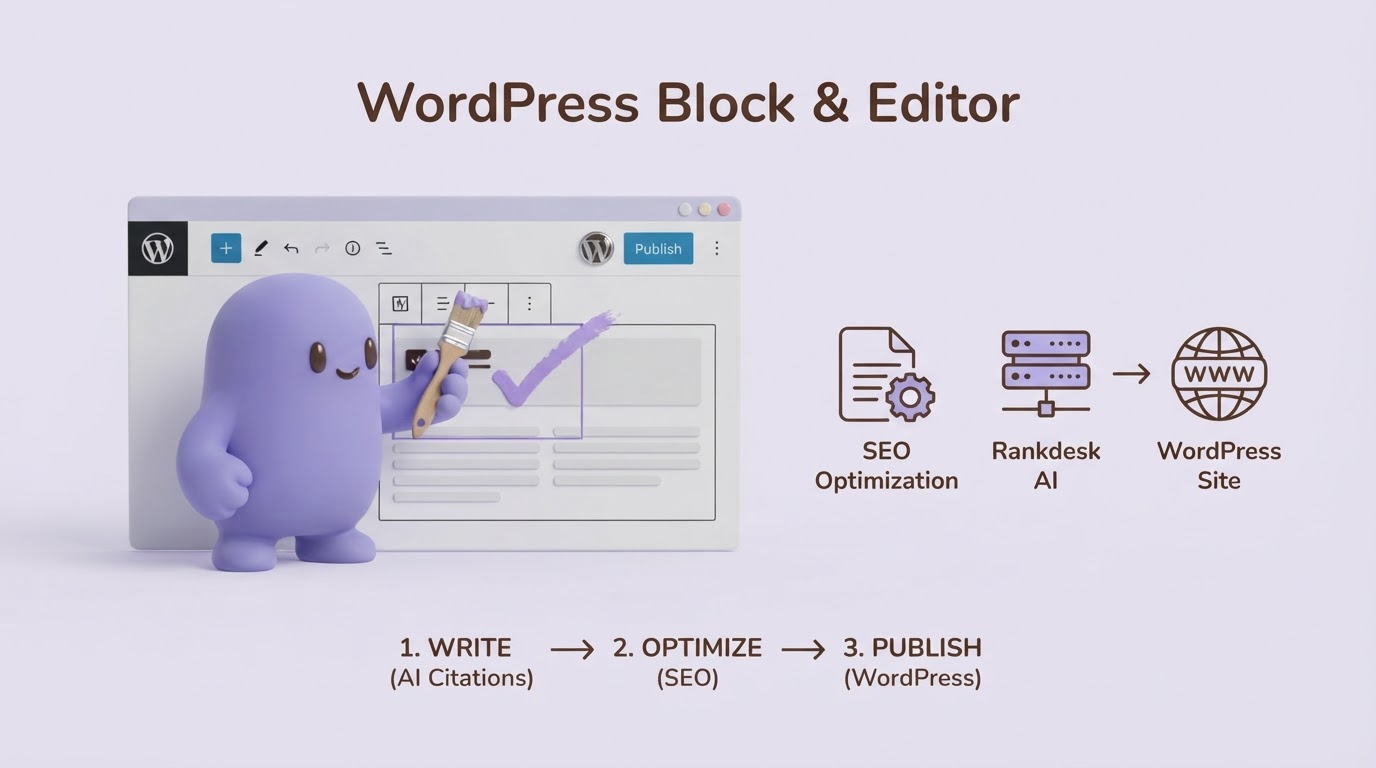
A manual process can work for a small editorial calendar, although it creates handoffs between research, drafting, editing, and publishing. Rankdesk helps organize the workflow inside one system while your team retains the final editorial judgment.
Here is how the water-filter manufacturer could run the article through Rankdesk and WordPress:
1. Start with the site and search opportunity
Add the domain and identify the target topic. Rankdesk can use site context, keyword opportunities, and competitor coverage to shape the article direction. The team selects the replacement-frequency topic because it supports an existing product category and has a clear facilities-management audience.
2. Set the brief before generating the draft
Specify the audience, target URL path, required product details, internal links, source expectations, and desired call to action. For this example, the planned WordPress slug is /commercial-water-filter-replacement-schedule/, with links to the filter range and quote request page.
3. Review the article structure and evidence
Review the generated title, direct answer, headings, tables, internal links, and citations. Add the technician's pressure-check procedure and approved model details. Remove any claim that lacks a reliable source or direct business evidence.
4. Send the approved piece to WordPress
Publish after editorial approval, then confirm the canonical URL, featured image, categories, on-page links, and indexability. Use the Rankdesk integrations page to review supported publishing connections, and see how Rankdesk works for the full workflow.
5. Improve the page after publication
Check Search Console queries, lead quality, and support questions. If searchers ask about pressure-drop thresholds, add that answer with a source and a clear inspection instruction. Keep the page current as products, standards, or customer needs change.
WordPress provides a practical editorial environment for businesses with an established content library. The related guide on a WordPress AI content writer workflow for rankings and AI citations shows how publishing consistency and quality control work together.
SEO article writer mistakes that reduce rankings and citations
The largest failure mode is publishing a polished draft without validating its claims. A page can sound authoritative while giving readers advice that lacks a source, misses a condition, or conflicts with your own product documentation.
Avoid these problems during review:
- Targeting a keyword without defining the reader's next action
- Repeating generic advice already covered by every result
- Using unsupported claims, fabricated examples, or vague expertise
- Linking every article to the homepage instead of relevant deeper pages
- Publishing without checking indexability, canonical tags, and page rendering
- Leaving old articles unchanged after products or search behavior shift
Use appropriate structured data when the page content qualifies. Google recommends following its structured data guidelines and ensuring markup reflects visible page content. Structured data supports eligibility for enhanced search appearances, while the page still needs useful information and solid technical foundations.
How to measure whether SEO articles are working
Track performance by article cluster rather than treating every page as an isolated project. The water-filter article may earn early impressions for maintenance questions, assist quote requests through internal links, and later build topical relevance for related installation and troubleshooting pages.
Review these signals monthly: query impressions, clicks, average position, engaged sessions, internal-link paths, form submissions, and sales feedback. Record the original publication date and each substantial update. A simple editorial log prevents accidental duplication and shows which additions changed performance.
For sites managing larger content programs, the SEO content workflow for agencies offers practical ways to standardize review across multiple clients and subject areas.
FAQ about SEO article writers
Can an SEO article writer create content for AI search results?
Yes. Strong source-backed articles with clear answers, specific entities, useful procedures, and accessible page structure give AI assistants more material to reference. Citation outcomes vary by assistant, query, and available sources, so focus on becoming a credible source across your topic cluster.
How much human review does an SEO article need?
Review every factual claim, product statement, recommendation, internal link, and call to action. Subject-matter review is especially important for regulated, technical, financial, legal, and health-related topics.
Should every SEO article target one keyword?
Give each page one primary search intent. Related terms and follow-up questions can appear where they help the reader complete the task. This approach keeps the page focused while allowing it to rank for closely related language.
Can I publish SEO articles automatically in WordPress?
Automated publishing can save operational time when briefs, source requirements, approval rules, and technical checks are already defined. Start with reviewed publishing for new topics, then expand automation for stable formats and well-governed content types.
If you want a more consistent way to plan, write, and publish search-focused articles, see how Rankdesk works. It researches your site, competitors, and keywords, then creates articles and landing pages your team can review or publish automatically.